


Quick Answer
Acetic acid (AA) is a simple organic acid and the main component of vinegar. Its CAS Number is 64-19-7, and its chemical formula is CH3COOH or C2H4O2. It is one of the most widely used organic acids in the chemical industry. Acetic acid is commonly found in vinegar, industrial solvents, pharmaceuticals, textile processing, food additives, and chemical manufacturing. As the primary component of vinegar (typically 4-10% by volume), it is one of the most widely produced industrial organic chemicals, with global annual production exceeding 14 million metric tons (IHS Markit, 2026).
What Is the CAS Number of Acetic Acid?
The Chemical Abstracts Service (CAS) Registry Number for acetic acid (ethanoic acid) is 64-19-7. This unique numerical identifier, assigned by the American Chemical Society, is the global standard for precise chemical identification across regulatory, logistics, and scientific applications.
The official CAS number of acetic acid is: 64−19−7
The CAS 64-19-7 number helps identify acetic acid chemicals accurately, avoid confusion between similar products.
This identifier eliminates ambiguity between:
- Propanoic acid (CAS 79-09-4)
- Formic acid (CAS 64-18-6)
- Chloroacetic acid (CAS 79-11-8)
When purchasing or exporting acetic acid chemical liquid, the CAS number 64-19-7 is commonly used in:
- SDS/MSDS documents
- Customs declarations
- Technical data sheets
- Shipping labels
- Chemical databases
What Is the Chemical Formula of Acetic Acid?
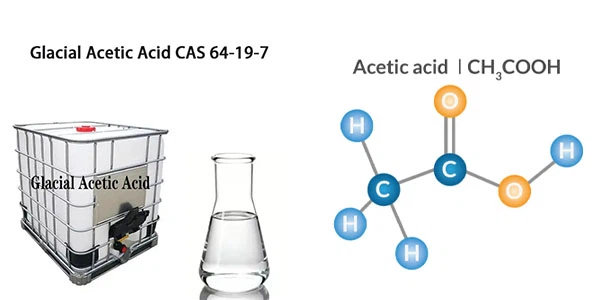
Acetic acid has the condensed structural formula CH₃COOH and the molecular formula C₂H₄O₂. The IUPAC systematic name is ethanoic acid. The molecular structure consists of a methyl group (-CH₃) covalently bonded to a carboxyl functional group (-COOH), giving it characteristic acidic properties.
Structural Representation
Condensed formula: CH₃COOH or CH₃CO₂H
- Line-angle formula: Commonly depicted in organic chemistry texts
- SMILES notation: CC(=O)O (standard for chemical databases)
- InChI Key: QTBSBXVTEAMEQO-UHFFFAOYSA-N (IUPAC identifier)
The carboxyl group (-COOH) is responsible for:
- pKa value of 4.76 at 25°C
- Weak acid behavior in aqueous solution
- Ability to form acetate salts and esters
What are the Properties of Acetic Acid CAS 64-19-7?
| Properties | Value |
| CAS No. | 64-19-7 |
| Molecular Formula | C₂H₄O₂ |
| Molecular Weight | 60.05 g/mol |
| Appearance | Clear Colorless Liquid |
| Odor | Pungent Vinegar-Like Odor |
| Density | 1.049 g/cm³ |
| Melting Point | 16.6°C |
| Boiling Point | 118.1°C |
| Flash Point | Approximately 39°C |
| Solubility | Completely Miscible with Water |
| Vapor | Pressure 15.7 mmHg at 20°C |
| Flammability | Flammable Liquid |
Common Uses of Acetic Acid AcOH chemical
Acetic acid (cas no 64-19-7) is a foundational chemical intermediate with 40% of global production used in vinyl acetate monomer (VAM) manufacturing, followed by 20% for acetate esters, 15% for purified terephthalic acid (PTA), and 10% for direct industrial solvent applications.
Chemical synthesis: Industrial acetic acid is an essential raw material in the synthesis of chemicals such as acetate esters and vinyl acetate monomers. These chemicals are further used in adhesives, paints, and textiles.
Pharmaceutical synthesis: 99.8% Glacial acetic acid is used as a catalyst or a solvent in active pharmaceutical ingredient (API) synthesis. For example, it is used as a solvent in the synthesis of aspirin, hormones, vitamins, etc.
Microbial growth prevention: Diluted glacial acetic acid liquid can inhibit microbial growth. Therefore, it is used to maintain the freshness of fruits and vegetables in the food industry. It is added to pickles, juices, and flavored drinks.
Surface cleaning: Acetic acid solvent can also be used as a disinfectant to clean surfaces. Because it is safe for consumption, it is used to clean food-preparation surfaces in the industry.
Analysis chemistry: It is also used in analytical chemistry. For example, it is commonly used as an industrial solvent in titration experiments.
Industrial and Food Grade Acetic Acid Supplier
Regulatory Compliance and Global Certification
Acetic Acid (CAS No.64-19-7) is regulated under multiple international regulatory frameworks. In the European Union, manufacturers and importers must comply with applicable REACH requirements. In the United States, acetic acid is listed on the TSCA Inventory. For food applications, food-grade acetic acid is commonly produced in accordance with FCC (Food Chemicals Codex) specifications and relevant national food safety standards.
Global Regulatory Status:
| Region / Standard | Compliance Status | Typical Certification |
|---|---|---|
| European Union | REACH Registered (where applicable) | REACH Registration |
| United States | TSCA Inventory Listed | FDA 21 CFR 184.1005, FCC |
| China | GB/T 1628-2020 Compliant | GB Standards |
| Food Industry | Food Grade Available | FCC, Kosher, Halal |
| Quality Management | ISO 9001 Certified Manufacturer | ISO 9001:2015 |
Frequently Asked Questions
Q: Is CAS No.64-19-7 the same for glacial acetic acid and vinegar?
Yes, CAS No.64-19-7 identifies acetic acid regardless of concentration. Glacial acetic acid refers to the anhydrous (≥99.8%) form, while vinegar typically contains 4-10% acetic acid in aqueous solution.
Q: Is glacial acetic acid the same CAS number as acetic acid?
Yes, glacial acetic acid (≥99.8% anhydrous) uses the same CAS number 64-19-7 as aqueous acetic acid solutions. The CAS number identifies the chemical substance itself, not concentration or purity grade.
Q: What is the difference between acetic acid and ethanoic acid?
They are the same chemical substance. "Acetic acid" is the common/trivial name, while "ethanoic acid" is the formal IUPAC systematic name. Both refer to CAS No.64-19-7.
Q: What UN number and hazard class applies to acetic acid?
Acetic acid solutions ≥80% concentration are classified as UN 2789, GHS Hazard Class 8 (Corrosive). Solutions below 25% concentration are generally not regulated as hazardous materials for transport.
Q: What is the shelf life of industrial glacial acetic acid?
24 months from manufacture date when stored in original sealed HDPE or steel drums at 15-25°C, protected from direct sunlight and moisture.
Q: Can acetic acid CAS No 64-19-7 be used for food applications?
Only food-grade acetic acid meeting FCC/GB/E260 standards is approved for food use. Industrial-grade material contains impurities unsuitable for human consumption.
Conclusion
Ethanoic acid/Acetic acid is an important industrial chemical, CAS number: 64-19-7, chemical formula: CH₃COOH
It possesses a variety of chemical properties, making it indispensable in industries such as chemical, food, textile, pharmaceutical, and manufacturing.
Understanding the CAS number, molecular formula, and physical properties of acetic acid chemical raw material helps purchasers, distributors, and manufacturers ensure proper selection, handling, transportation, and application.
about us
As a leading manufacturer and exporter of chemical solvent, TIANJIN GNEE BIOTECH CO., LTD. provides high-quality industrial chemicals. We supply to customers across the chemical, pharmaceutical, and materials industries, ensuring consistent quality, reliable logistics, and professional technical support.
Our chemical products hold international certifications (REACH, ISO, FMQS, HALAL) for global quality recognitio. We have warehouses in coreports such as Qingdao, Tianiin, and Shanghai, with a 15-day express delivery service.
Other Hot-Selling Products
| Dimethyl Sulfoxide (DMSO) | CAS 67-68-5 |
| Dichloromethane / Methylene Chloride | CAS 75-09-2 |
| Glacial Acetic Acid / Ethanoic Acid | CAS 64-19-7 |
| Ethyl Acetate / Ethyl Ethanoate | CAS 141-78-6 |
| Ethylene Glycol / Monoethylene Glycol (MEG) | CAS 107-21-1 |
| Trichloroethylene | CAS 79-01-6 |
| Cyclohexanone | CAS 108-94-1 |
GNEE BIO Product Packaging
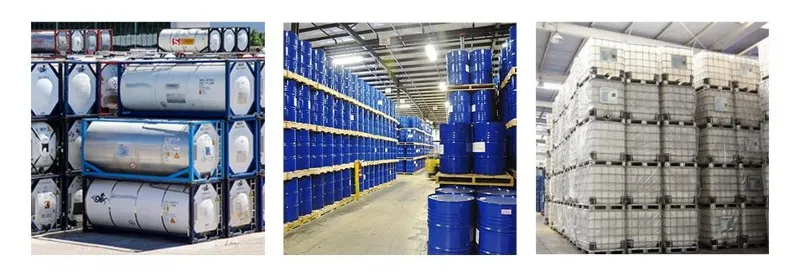
| Packaging Type | Net Weight |
|---|---|
| Steel Drum | 250 kg |
| IBC Tank | 1250 kg |
| ISO Tank | Bulk shipment |
Customer Visit
